
Low-Maintenance Hedge Trimming & Bush Shaping – Garden Care Guide 2026
Within high-density neighbourhoods such as Poplar, homeowners are increasingly looking for ways to keep gardens neat without constant upkeep. This has led to a strong rise in low-maintenance hedge trimming and bush shaping, where the goal is not frequent cutting, but long-lasting structure with minimal intervention.
Rather than repeated heavy pruning, modern gardens now focus on easy-care hedge shaping, controlled growth, and carefully formed ornamental bushes that retain their structure for longer periods. This approach is ideal for small urban gardens where time, access, and space are limited.
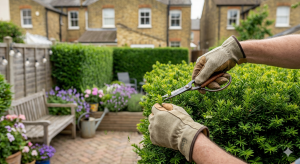
Why Low-Maintenance Hedge Trimming and Bush Shaping Is Trending
Urban homeowners are moving away from labour-intensive garden routines and towards smarter, more sustainable maintenance methods. Key reasons for this shift:
- Reduced time available for regular garden maintenance
- Smaller urban gardens requiring efficient use of space
- Desire for clean, structured outdoor living areas
- Need to minimise disruption in tightly packed residential areas
- Preference for “trim less often” hedge strategies
- Growing popularity of architectural garden design styles
What Is Low-Maintenance Hedge Trimming and Bush Shaping?
Low-maintenance hedge trimming is a structured approach to controlling hedge growth so that it retains shape without frequent cutting.
Bush shaping complements this by focusing on ornamental shrubs, sculpting them into long-lasting forms that require only occasional refinement rather than constant pruning.
Together, they create a unified garden structure that is both visually appealing and easy to maintain.
Hedge Trimming vs Bush Shaping: What’s the Difference?
Although often used together, hedge trimming and bush shaping serve slightly different purposes.
Hedge trimming:
- Focuses on boundary structure and privacy
- Maintains straight lines or tapered edges
- Typically used for perimeter planting
Bush shaping:
- Focuses on individual shrubs and ornamental plants
- Creates rounded, architectural, or natural forms
- Used as feature planting within garden spaces
When combined, they create a balanced, layered garden design suitable for compact urban environments.
Easy-Care Hedge Shaping Techniques for Urban Gardens
In small London gardens, precision and restraint are key to reducing maintenance needs.
1. Tapered Structural Shaping (A-Frame Method)
Hedges are shaped wider at the base and narrower at the top, improving light distribution and reducing patchy growth.
2. Soft Natural Shaping
Instead of rigid geometric lines, hedges are lightly shaped into natural flowing forms that require fewer corrections.
3. Minimal Seasonal Adjustment
Rather than heavy seasonal pruning, only light trimming is carried out to maintain overall structure.
Bush Shaping Techniques for Low-Maintenance Gardens
Bush shaping plays a major role in modern easy-care hedge trimming in London gardens, especially in decorative and compact spaces. Popular bush shaping styles:
1. Rounded Form Shaping
Ideal for shrubs like box or lavender, creating soft, compact spheres that retain shape for long periods.
2. Cloud Pruning Style
A more artistic approach where bushes are shaped into layered “cloud-like” forms with natural spacing.
3. Architectural Column Shaping
Tall, narrow bushes shaped into vertical forms for structure and screening in tight urban spaces.
4. Informal Natural Shaping
Light trimming that enhances natural growth without forcing strict geometry.
Slow-Growing Hedge and Bush Selection
Plant choice is essential for reducing maintenance frequency.
Best low-maintenance options:
- Yew (Taxus baccata) – ideal for structured shaping
- Box (Buxus sempervirens) – perfect for formal bush shaping
- Laurel – dense and resilient for hedging
- Lavender – excellent for low ornamental bush shaping
- Griselinia – fast establishing but easy to maintain
These plants are commonly used in low maintenance urban gardens due to their predictable growth habits.
“Trim Less Often” Hedge and Bush Strategies
Modern garden design prioritises reduced intervention while maintaining structure. Key strategies include:
- Establishing shape early during planting phase
- Encouraging dense growth from the base
- Avoiding over-pruning, which increases regrowth speed
- Allowing natural structure to stabilise between trims
- Using mulch and soil conditioning to regulate growth rate
These strategies are especially effective in small urban gardens in areas like Poplar where access is limited.
Designing Small Urban Gardens with Hedge and Bush Structure
In compact London gardens, hedges and shaped bushes are not just decorative—they define the entire structure of the space.
Effective design approaches:
- Low hedges for zoning seating and walking areas
- Tall structured hedges for privacy screening
- Bush clusters as focal points in corners
- Mixed-height planting for depth and layering
This creates a balanced low-maintenance garden structure in urban environments.
Common Mistakes in Hedge and Bush Maintenance
Poor maintenance practices often lead to higher long-term effort. Frequent issues include:
- Over-trimming leading to weak regrowth
- Ignoring early shaping, causing irregular structure
- Choosing fast-growing species unsuitable for small gardens
- Cutting too frequently instead of allowing stabilisation
- Poor light access due to incorrect hedge placement
Avoiding these mistakes is key to achieving a truly low-maintenance result.
Benefits of Low-Maintenance Hedge Trimming & Bush Shaping
- Reduces frequency of garden maintenance
- Creates long-lasting structural design
- Improves privacy in dense urban areas
- Enhances visual order in small gardens
- Minimises disruption from regular cutting
- Supports modern low-effort lifestyle gardening
Bush Shaping Trends in 2026 Urban Garden Design
Modern landscaping is shifting towards controlled naturalism rather than strict geometry. Current trends include:
- Soft sculpted bush clusters instead of rigid topiary
- Mixed hedge and bush layering for depth
- Minimal cutting with natural form retention
- Integration of ornamental bushes into edible or mixed gardens
- Architectural hedge framing for small patios
These trends are particularly strong in compact London gardens.
Final Thoughts
Low-maintenance hedge trimming and bush shaping in London represents a major shift in urban garden design. Instead of constant cutting and high upkeep, the focus is now on intelligent planting, early structure development, and long-term form stability.
In dense areas like Poplar, where space is limited and gardens are often overlooked, this approach creates clean, structured, and visually appealing outdoor environments with minimal effort.
By combining easy-care hedge shaping techniques, thoughtful bush sculpting, and slow-growing plant selection, homeowners can achieve a professional-looking garden that remains stable and attractive throughout the year.
Professional Gardening Tips, Tricks, and Maintenance Insights for Poplar Gardens
- Garden Maintenance Packages in Poplar, London: Weekly & Monthly Garden Care
- Low-Maintenance Hedge Trimming & Bush Shaping – Garden Care Guide 2026
- Edible Gardens in London: Foodscaping & Grazing Garden Design for Modern Urban Living
- Garden Clearance & Restoration in Poplar, London: Transforming Overgrown Urban Gardens into Usable Outdoor Spaces
- Small Patio Transformation in Dense Urban Areas Like Poplar
- Small-Space & Urban Gardening: Maximising Every Inch in Modern London Homes
- Sustainable & Climate-Resilient Gardening: Future-Proof Your Garden for 2026 and Beyond
- Spring Garden Maintenance: What You Should Be Doing Right Now